Consistent and Durable Data Structures for Non-Volatile Byte-Addressable Memory
Consistent and Durable Data Structures for Non-Volatile Byte-Addressable Memory
Shivaram Venkataraman, Niraj Tolia, Parthasarathy Ranganathan, and Roy H. Campbell in Proceedings of File Systems and Storage Technology 2011, Volume 11, pp 61-75, USENIX.
In this paper the authors turn their attention to data structure considerations for Non-Volatile Memory (NVM). Unlike the previous papers I have covered (Mnemosyne and NV-Heaps) they look at data structures specifically optimized to exploit the capabilities of NVM. From the abstract:
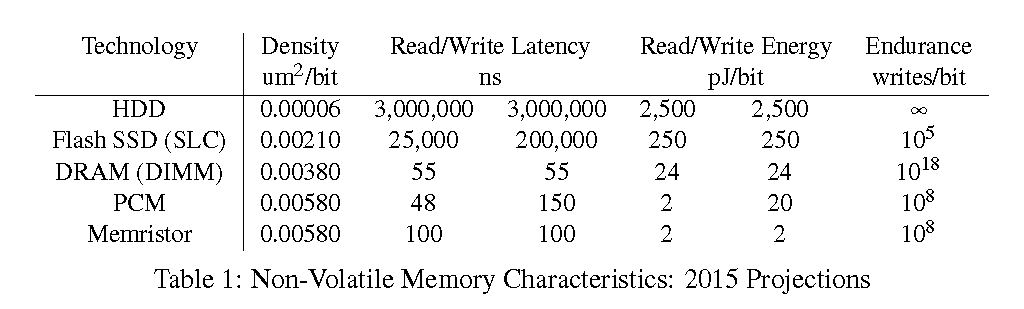
 The paper has a good review of NVM memory technologies that may emerge. Table 1 (from the paper) underscores the dramatic decrease in latency. This is why we've been waiting for this for more than 10 years now. It really does change the platform in ways that we have not yet realized.
But it is not just the speed aspect that matters, it is also the persistence aspect. The density is much larger for these memories as well. Anyone that has looked at an NVMe M.2 drive can notice how few and small the components on it.
Do we treat it as storage? If so, perhaps we should look to the file systems world for some insight. The authors turn to the WAFL shadow page mechanism. They point to BTRFS and their use of this technique with B-trees. They dismiss this approach, concluding that they have "fewer data-copies" in CDDS. They distinguish this work because it is byte addressable versus prior work that was block oriented (page addressable). Again, the lessons learned from working with it aren't directly applicable. They do point out that using NVM makes sense in a world of large, persistent storage backed data farms. So there is a need, and one they see fulfilled by NVM. It just needs efficient use of that NVM.
Thus, the authors walk their own path.
The paper has a good review of NVM memory technologies that may emerge. Table 1 (from the paper) underscores the dramatic decrease in latency. This is why we've been waiting for this for more than 10 years now. It really does change the platform in ways that we have not yet realized.
But it is not just the speed aspect that matters, it is also the persistence aspect. The density is much larger for these memories as well. Anyone that has looked at an NVMe M.2 drive can notice how few and small the components on it.
Do we treat it as storage? If so, perhaps we should look to the file systems world for some insight. The authors turn to the WAFL shadow page mechanism. They point to BTRFS and their use of this technique with B-trees. They dismiss this approach, concluding that they have "fewer data-copies" in CDDS. They distinguish this work because it is byte addressable versus prior work that was block oriented (page addressable). Again, the lessons learned from working with it aren't directly applicable. They do point out that using NVM makes sense in a world of large, persistent storage backed data farms. So there is a need, and one they see fulfilled by NVM. It just needs efficient use of that NVM.
Thus, the authors walk their own path.
 The speed of NVM is such that direct access is the only mechanism that makes sense. System calls impose too much overhead, doubling the cost of accessing the NVM itself. Thus they posit that it will be direct access (and indeed that is what seems to come to pass).
They observe that one of the challenges for persistent data is that CPUs do not provide mechanisms for ordering persistent writes (though they do, but at a fairly coarse granularity of a fence.) So they describe the issues that must be handled:
The speed of NVM is such that direct access is the only mechanism that makes sense. System calls impose too much overhead, doubling the cost of accessing the NVM itself. Thus they posit that it will be direct access (and indeed that is what seems to come to pass).
They observe that one of the challenges for persistent data is that CPUs do not provide mechanisms for ordering persistent writes (though they do, but at a fairly coarse granularity of a fence.) So they describe the issues that must be handled:
For these systems, where no distinction is made between a volatile and a persistent copy of data, we present Consistent and Durable Data Structures (CDDSs) that, on current hardware, allows programmers to safely exploit the low-latency and non-volatile aspects of new memory technologies. CDDSs use versioning to allow atomic updates without requiring logging.Some other aspects of this paper that stand out:
- They are looking at NVM replacing both DRAM and storage - thus, they view this as a single level store.
- They use versioning to protect their data structures, versus logging.
- They describe how to achieve this without hardware changes.
 The paper has a good review of NVM memory technologies that may emerge. Table 1 (from the paper) underscores the dramatic decrease in latency. This is why we've been waiting for this for more than 10 years now. It really does change the platform in ways that we have not yet realized.
But it is not just the speed aspect that matters, it is also the persistence aspect. The density is much larger for these memories as well. Anyone that has looked at an NVMe M.2 drive can notice how few and small the components on it.
Do we treat it as storage? If so, perhaps we should look to the file systems world for some insight. The authors turn to the WAFL shadow page mechanism. They point to BTRFS and their use of this technique with B-trees. They dismiss this approach, concluding that they have "fewer data-copies" in CDDS. They distinguish this work because it is byte addressable versus prior work that was block oriented (page addressable). Again, the lessons learned from working with it aren't directly applicable. They do point out that using NVM makes sense in a world of large, persistent storage backed data farms. So there is a need, and one they see fulfilled by NVM. It just needs efficient use of that NVM.
Thus, the authors walk their own path.
The paper has a good review of NVM memory technologies that may emerge. Table 1 (from the paper) underscores the dramatic decrease in latency. This is why we've been waiting for this for more than 10 years now. It really does change the platform in ways that we have not yet realized.
But it is not just the speed aspect that matters, it is also the persistence aspect. The density is much larger for these memories as well. Anyone that has looked at an NVMe M.2 drive can notice how few and small the components on it.
Do we treat it as storage? If so, perhaps we should look to the file systems world for some insight. The authors turn to the WAFL shadow page mechanism. They point to BTRFS and their use of this technique with B-trees. They dismiss this approach, concluding that they have "fewer data-copies" in CDDS. They distinguish this work because it is byte addressable versus prior work that was block oriented (page addressable). Again, the lessons learned from working with it aren't directly applicable. They do point out that using NVM makes sense in a world of large, persistent storage backed data farms. So there is a need, and one they see fulfilled by NVM. It just needs efficient use of that NVM.
Thus, the authors walk their own path.
 The speed of NVM is such that direct access is the only mechanism that makes sense. System calls impose too much overhead, doubling the cost of accessing the NVM itself. Thus they posit that it will be direct access (and indeed that is what seems to come to pass).
They observe that one of the challenges for persistent data is that CPUs do not provide mechanisms for ordering persistent writes (though they do, but at a fairly coarse granularity of a fence.) So they describe the issues that must be handled:
The speed of NVM is such that direct access is the only mechanism that makes sense. System calls impose too much overhead, doubling the cost of accessing the NVM itself. Thus they posit that it will be direct access (and indeed that is what seems to come to pass).
They observe that one of the challenges for persistent data is that CPUs do not provide mechanisms for ordering persistent writes (though they do, but at a fairly coarse granularity of a fence.) So they describe the issues that must be handled:
- Reordering of writes from the caching behavior of the CPU itself as well as a multi-level cache hierarchy.
- Failure semantics of atomic operations across power failures.