Granularity of Locks in a Shared Data Base
Granularity of locks in a shared data base,
Jim N. Gray, Raymond A. Lorie, Gianfranco R. Putzolu, in Proceedings of the 1st International Conference on Very Large Data Bases, pp. 428-451. ACM, 1975.
I was originally going to do a write-up of A Client-Based Transaction System to Maintain Data Integrity but realized that I should help motivate the use of locks and transactions better before diving into this topic area. So to do this, I've picked to talk about locks. This is a critical concept that we utilize in file systems development on a routine basis. Note that this work actually started out in the database community, not the file systems community.
I will note that this is a long paper (23 pages) and there is considerable detail that I will omit for the sake of brevity - but I do want to touch on the key points that are raised in this paper.
They start off by defining consistency and transaction. They define consistency first:
 The optimal configuration for resource sharing is where the need to share is minimized. If there is no shared data, there is no need for locks. Similarly, if the data is immutable (a concept I know we'll return to over time) we don't need to protect it. Only mutable state needs to use locks. As it turns out, frequently mutable state doesn't actually change but because it can change, if we rely upon it, we must protect against change.
This concept of transitioning from one consistent state to another consistent state safely is why we use locks. The primary contribution of the authors in this paper is not the creation of locks and consistency but rather their creation of a clear language that we still use to describe these concepts.
In Section 2 they then describe what a "lockable object" is. There are several important observations here, which I summarize:
The optimal configuration for resource sharing is where the need to share is minimized. If there is no shared data, there is no need for locks. Similarly, if the data is immutable (a concept I know we'll return to over time) we don't need to protect it. Only mutable state needs to use locks. As it turns out, frequently mutable state doesn't actually change but because it can change, if we rely upon it, we must protect against change.
This concept of transitioning from one consistent state to another consistent state safely is why we use locks. The primary contribution of the authors in this paper is not the creation of locks and consistency but rather their creation of a clear language that we still use to describe these concepts.
In Section 2 they then describe what a "lockable object" is. There are several important observations here, which I summarize:
We assume the data base consists of a collection of records and constraints defined on these records. There are physical constraints (ex: in a list of records, if a record A points to record B then record B must exist) as well as logical constraints (ex: conservation of money in a bank checking account application). When all such constraints are satisfied the data base is said to be consistent.Then they move on to transaction:
A transaction is a series of accesses (for read or write operations) to the data base which, applied to a consistent data base, will product a consistent data base. During the execution of a transaction, the data base may be temporarily inconsistent. The programs used to perform the transactions assume that they "see" a consistent data base. So if several transactions are run concurrently, a locking mechanism must be used to insure that one transaction does not see temporarily inconsistent data cause by another transaction. Also, even if there are no consistency constraints, locks must be used so that the updates of one transaction are not made available to others before the transaction completes. Otherwise, transaction backup might cascade to other transactions which read or updated the "back up" updates.This text does not lay out the modern description of transactions that we use (atomic, consistent, isolated, and durable or ACID) but what it describes is a system in which these properties do in fact exist. This concept is not unique to databases - we see it in any multi actor system sharing resources. The usual analogy that I use when describing this are traffic intersection based, as the intersection is a shared resource and the individual vehicles separate actors.
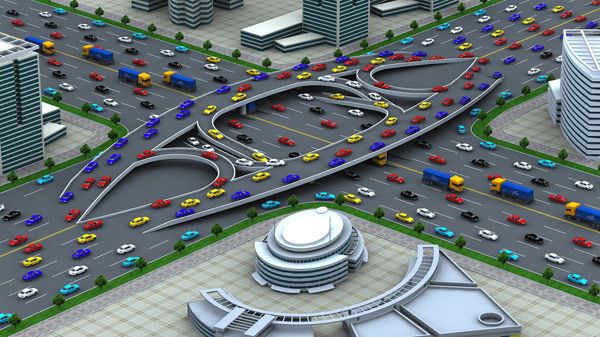 The optimal configuration for resource sharing is where the need to share is minimized. If there is no shared data, there is no need for locks. Similarly, if the data is immutable (a concept I know we'll return to over time) we don't need to protect it. Only mutable state needs to use locks. As it turns out, frequently mutable state doesn't actually change but because it can change, if we rely upon it, we must protect against change.
This concept of transitioning from one consistent state to another consistent state safely is why we use locks. The primary contribution of the authors in this paper is not the creation of locks and consistency but rather their creation of a clear language that we still use to describe these concepts.
In Section 2 they then describe what a "lockable object" is. There are several important observations here, which I summarize:
The optimal configuration for resource sharing is where the need to share is minimized. If there is no shared data, there is no need for locks. Similarly, if the data is immutable (a concept I know we'll return to over time) we don't need to protect it. Only mutable state needs to use locks. As it turns out, frequently mutable state doesn't actually change but because it can change, if we rely upon it, we must protect against change.
This concept of transitioning from one consistent state to another consistent state safely is why we use locks. The primary contribution of the authors in this paper is not the creation of locks and consistency but rather their creation of a clear language that we still use to describe these concepts.
In Section 2 they then describe what a "lockable object" is. There are several important observations here, which I summarize:
- A transaction is sequentially consistent. This is a very strong consistency guarantee (as we will see in later papers when things get far more general.)
- The basic lock type is reader-writer. A reader lock provides shared access to mutable state, along with the guarantee that the mutable state won't change while the lock is held. A writer lock provides exclusive access to mutable state, along with the guarantee that the only changes to that state will be made by the owner of the writer lock.
- Locks may be used to protect non-existent resources, for example, to block the creation of a new object. Since the object doesn't exist, you can't lock it yet (interestingly, I usually tend to think of that as locking the structure in which the new object exists, but their observation that you can lock non-existent items is certainly valid.
- Locks are requested dynamically.
- There is a dynamic balance between lock granularity and overhead. If we lock many small objects, there is a cost associated with each of those lock operations. In the years since this paper we have made uncontended lock acquisition rather inexpensive, but contended lock acquisition remains an expensive proposition.